29 August 2011


"In a sample of the residents interviewed, it was found that for above-ground dwellers of white-collar occupation, 4 out of 10 would be prepared to live in modern earth-covered housing compared to 8 out of 10 of the total sample. For these people, a large brick house was a cue to socioeconomic status. The fact that they chose to live above-ground despite the obvious drawbacks such as air-conditioners which were often inoperative due to irregular and uncertain power supply and clogging dust in fierce temperatures, suggest that some people must have had good reasons for so doing (as the lifestyle was adopted in spite of its obvious drawbacks.) Unfortunately these reasons were not investigated as they were not relevant to the subject of the research, but the following statements epitomize their attitudes: "I'm hot and miserable, but it's a good way to live—above-ground." "They're cooler underground and a lot more comfortable, but I still think above-ground is better." Most Australians and British people stated that they would live underground in modern earth-covered housing, whereas a high proportion of Greeks and Italians said they would not. Apart from the variables of racial origin the extreme climate was the main reason given for adopting the underground lifestyle, one English underground subject (U.Ss) commenting: sane sorts of people who want to get out the heat live underground." Approximately half of the residents of Coober Pedy lived above-ground and half underground; hence all either had experience with or at least knowledge of, the advantages and disadvantages of the underground lifestyle. Survey results indicated that 75 per cent of the population sample (including 50 per cent of the above-ground subjects, A.Ss) stated that, given the opportunity, they would live in modern earth-covered homes.
The sampling procedure followed was that of attempting to obtain an equal number of above and below-ground subjects. However, a disproportionate amount of time was spent in the field trying to equalise the numbers of above-ground subjects and underground subjects. Despite heroic efforts made on the part of interviewers when unbearable conditions prevailed (daily temperatures maxima ranging from 40 to 46 degrees C with dust storms blowing for half the period that the survey was in progress), and sometimes under threatening circumstances of savage guard dogs and gun-carrying home-owners, it was not possible to achieve equal sample numbers. Of all A.Ss approached, it was only possible to interview 26-per cent of them. When U.Ss were approached, without exception all agreed to be interviewed. The attitude of most U.Ss was open and enthusiastic. Even before the purpose of the survey as stated interviewers reported that a distinct attitudinal difference existed between A.Ss and U.Ss. A major proportion of A.Ss were suspicious, stating they thought the interviewer was a taxation official. Amongst those A.Ss who refused to be interviewed, there were some who were unexpectedly aggressive or abusive, those who slammed doors without speaking, those who shouted through closed doors: "Go away," and others who did not answer the doorknock even though sounds could clearly be heard from within. Most U.Ss gave their names freely and were eager to answer the questions and talking about living underground. (...)
That there were obvious differences towards the interviewers in the attitudes of most A.Ss compared to U.Ss was surprising. What could have caused these differences in attitude? Both sexes and a wide range of occupations, nationalities and age groups were represented in both groups. It seems reasonable to infer that environmental determinism of some type was operating. Although there were many variables involved, all environmental factors: heat, glare, drying winds, dust, geographic isolation, long periods of summer temperatures, and so on, would have been experienced by all respondents. However, the one factor that clearly separated the population of this multiracial township (52 nationalities were recorded) was the adopted mode of living. Occupants of conventional above-ground dwellings would have been more exposed to many of these environmental factors, while those in dugouts would have been comparatively sheltered.
To facilitate discussion on these observations, it is necessary to explain a concept originally proposed by Mehrabian and Russell, ad adopted here. Pleasure, arousal and dominance are considered as mediating variables (between environmental stimuli and resultant behavioural responses), and used to describe degrees of anxiety in relative terms of low pleasure, high arousal and low dominance. As used here, "pleasure," "arousal" and "dominance" have the following meanings:

"Pleasure: Pleasure/displeasure is a feeling state that can be...assessed with self-report...behavioural indicators...scored on a dimension of pleasantness...independent of their own arousal quality and dominance-submissiveness. Thus these cues provide an important behavioural end...pleasure is distinguished from preference, liking, positive reinforcement of approach-avoidance.
Arousal: A feeling state varying along a single dimension ranging from sleep to frantic excitement...most directly assessed by verbal report.
Dominance: Dominance-submissiveness is a feeling state that can be assessed from verbal reports...An individual's feeling of dominance in a situation is based on the extent to which he feels unrestricted or free to act in a variety of ways."


In the literature, certain environmental physical factors that have been associated with higher levels of arousal may have been influencing A.Ss. As A.Ss would have been subjected to an increased degree of exposure (compared to U.Ss), the possibility that this may have contributed to their attitude is discussed under the following headings:
1. Above-ground Subjects (A.Ss): Possible increased sensory stimulation from the environment due to conditions of: (a) low humidity; (b) high temperatures; (c) wind exposure; (d) glare and high levels of illumination; (e) positive air ionisation.
2. Underground Subjects (U.Ss): Possible decreased sensory stimulation from the environment due to conditions of: (a) absence of, or reduction in the number of windows; (b) noise attenuation; (c) heat and light, low intensity effects."

—Dr. Sydney A. Baggs "Environmental Factors Possibly Influencing Attitude in Australians Living in Above- and Below-Ground Dwellings in Arid Region Mining Town" in Report on the International Symposium on Earth Architecture, March 1986


27 August 2011

The triumph of a public art


"At issue now is the positioning and posture of King in the 28-foot-tall statue that will greet visitors when the memorial is completed in 2009. Last year, the foundation caused a stir among some in the African-American community, particularly the Black art community, when it chose Lei Yixin--a Chinese "master sculptor" who has carved monuments of many of China's most prominent figures, including Mao Zedong, father of communist China--to design the monument of King.

Lei's goal, which was approved early in the planning process by the commission, was to depict King as a towering figure emerging from the "Mountain of Despair" to the "Stone of Hope." But in a letter written to the Martin Luther King Jr. National Memorial Project Foundation on April 28, the seven-member, all-White fine arts commission expressed concern that without further refinements, including changes to make King look more "sympathetic," the sculpture would be "inappropriate as an expression of [King's] legacy."

"The original concept showed an image of Dr. King that was asymmetrically composed, dynamic in stance, meditative in character, and modeled as if emerging from the Stone of Hope," the letter stated. "[But] the development as shown now features a stiffly frontal image, static in pose, confrontational in character-and appearing as if it had been affixed to the surface of the Stone of Hope."

The letter from the commission went on to criticize the technique represented by the statue, saying, "The colossal scale and Social Realist style of the proposed statue recalls a genre of political sculpture that has recently been pulled down in other countries."

The commission "recommended strongly that the sculpture be reworked, both in form and modeling, to return to a more sympathetic idea of the figure growing out of the stone with increasing detail and emphasis of the upper part of the figure."

In an interview with JET, Thomas E. Luebke, secretary of the fine arts commission, said that, while the language in the letter is strongly worded, the changes being requested are relatively minor. "It's subtle things," Luebke said. "There seems to be a shift from where it was to where it is now. Our interest is aesthetic. The commission has always supported the concept, the idea and design of the memorial. What we are asking is nothing drastic."

Foundation President Harry S. Johnson said that the objections of the commission, whose approval is necessary for the project to move forward, are part of a long back-and-forth process that every memorial has had to go through. Johnson said that the foundation plans to make minor "tweaks," including setting King's body back into the stone more, in hopes of satisfying the commission's desire to make King appear less dictatorial.

"This is normal," Johnson said. "If you look at the big memorials on the Mall, they all go through a very lengthy, and important, discussion because everyone wants it to be correct."

But even with these changes, some Black artists, including sculptor Ed Dwight, who had vied to be the project's sculptor, believe that depiction of King is anything but correct. Dwight has said that King would "be spinning in his grave" at the idea of a representative of the Chinese government--which once called King "a political lapdog"--being the lead sculptor of the memorial.

"This guy knows nothing about King," said Dwight of Lei, who is collaborating with Black artists James Chaffers and Jon Lockard, both University of Michigan professors, on the sculpture. "I've seen his rendering. It's not a good likeness of King. King never stood like that. He's standing with his legs spread like he's guarding something. His brow is larger than it should be. King never wore a bulky suit on that. The suit looks like the kind of suit that the Chinese people wear.""

—Kevin Chappell
JET Magazine

18 August 2011

Hello, Vegetable! 你吃了吗?


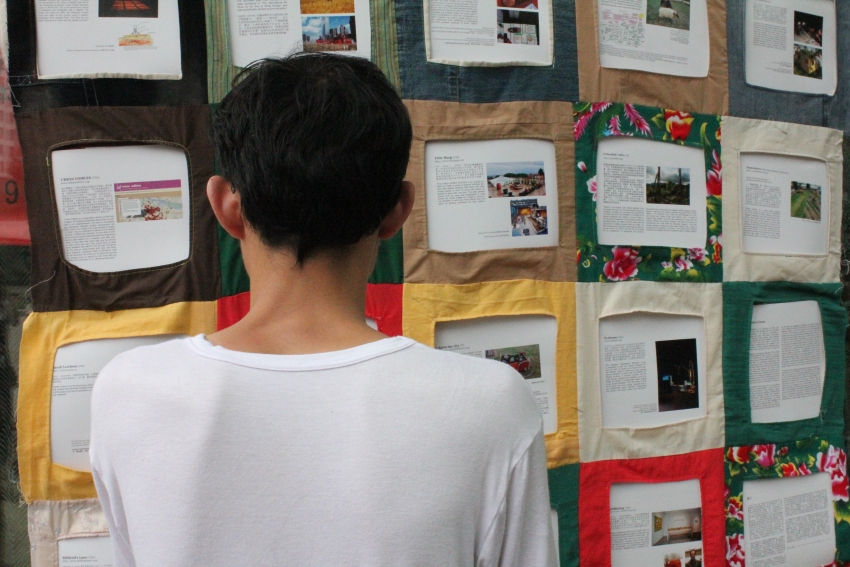
“Have you eaten yet?” is a collection of artist practices that work with farming and food production and consumption. It is meant as a database to find, compare and learn from these art practices, and their intentions, their methods, their networks. This is an ongoing list being compiled for the project Country Fair, within the context of China and the information available here, but it seeks to connect information of these practices internationally. It is presented online as well as at each Country Fair.

《你吃了吗?》是一篇有关农业以及食品生产和消费的艺术家实践汇编。本汇编相当于一个 数据库,其目的是帮助人们收集,对比,和学习这些艺术家的实践,意图,方法,社会网络。它是一 个正在进行中的列表,这一列表是在中国的语境和可获得的信息条件下为《市集/Country Fair》项目 所做的。但它也寻求这类实践的国际信息。本汇编在网络和市集上都可以找到。 因为这类艺术实践在现代艺术中谈及的较少,所以本数据库是很有必要的。颇具讽刺的是可及性还是许多这类艺术 家的项目所关注的。泛泛地说,虽然这些艺术实行常常跟本地环境、经济和社会体 系有关,但是它们大部分也关系到共有知识网络,在许多情况下 也巧妙地,综合地使用了科技手段。 当 然,艺术家个人网站上的信息是更深入的;《你吃了吗?》只是走近他们工作的一个切入点 。

请访问! Please visit!
http://www.homeshopbeijing.org/nichilema/

16 August 2011

"this is authentic"

e

"There was a time when the image of the voter was limited to a person in an institutional or economic role—trade unionist, organization man, bureaucrat, manager of the domestic economy, reproducer of labour power or whatever. Early socialism was based on the sibling-like solidarity of fraternalism and male bond­ing which moved on to the caring mother model of the postwar welfare state. Conservatives tended more to a paternalist mode—being a more or less kindly father, doing what was necessary for the family business to continue without unnecessary inter­ruption. Voters/children were to be seen and not heard and should be grateful for whatever was done for them and should certainly fight for their rulers when told to do so. Admittedly this shifted to a determination to make the children stand on their own feet and not be "moaning minnies" in Mrs Thatcher's phrase, always asking for a helping hand instead of just getting on with it. Politicians fall easily into fatherly or motherly roles, chiding voters for not recognizing the difficult time they have in providing for 'the family', that is, all of them, and keeping the United Kingdom neat and clean and safe.

Rarely do politicians relate to voters in a truly unpatronizing and friendly way, expressing their feelings and hopes as one friend might to another. Nor do politicians let us see them as people enjoying pure friendly relations: we see them formally as mothers and fathers or patrons and clients, yet their close personal friend­ships remain hidden from view. If the family is the chief model for political relations, with much parliamentary debate being, as it were, a struggle between the authority of the father and the authority of the mother, this produces a highly directive, secretive and exclusive style of politics.­ The voters as children or siblings can do little more than react to what is done on their behalf. They cannot engage as friends. The more the political process is centralized, the greater will be this tendency. The principle of subsidiarity, to locate responsibility for decisions and actions at the lowest possible level, is certainly more friendly.

The larger formations of social life—kinship, the law, the economy—must be different where there is, in addition to solid­arity and dutiful role performance, a willingness and capacity for friendship's surprising one-to-one relations. This difference alone may be enough to transform social and political life."

—Ray Pahl, "Friendship: the Social Glue?" in The Politics of Risk Society


7 August 2011


"The idea of sleep as dream = caught up in a mythology of productivity, of work: "dream-work": sleep is useful for something; not only does it restore, "regain," "recuperate," it also transforms, labors: it is productive, rescued from the disgrace of the "good for nothing." (Psychoanalysis instituted the idea of the producing dream, material for analysis. Ideology of work: one doesn't dream "for nothing") ≠ utopian sleep (dreamless), falling asleep: unproductive : is even defined by the fact that it is a kind of unconditional expenditure (= the very essence of "perversion": all in all, it would be a perverse sleep):
1. Affinity with drugs, since, in both cases (Also Rescio on Walter Benjamin and H), it is a matter of "immersing one's important thoughts into a long sleep," into a "non-place," into the "fatherless" (but obviously not the "motherless": (worn out!) theme of the fetal sleep).
2. Affinity with the theme of immortality, through the figure of suspended time. Recall a frequent theme of the iconography of Greek vases or reliefs: night distributes its poppies, which are like the plant of immortality.
Diogenes Laertius tells a very beautiful story about Epimenides (one of seven wise men): "He was a native of Knossos in Crete, though from wearing his hair long he did not look like a Cretan. One day he was sent into the country by his father to look for a stray cheep, and at noon he turned aside out of the way, and went to sleep in a cave, where he slept for fifty-seven hours. After this he gt up and went in search of his sheep, thinking he had been asleep only a short time. [...] So he became famous throughout Greece, and was believed to be a special favorite of heaven. [...] He lived one hundred and fifty-seven years." To take note of (at least in my view):
a. Selective suspension of time: his body ages, but his memory does not: he looks for his sheep; interestingly enough, I believe, since memory is not an act of pure recollection of the past, as if it were external to time the better to grasp it: memory is itself submitted to time, to its injustices → cf. process of writing that I have called anamnesis, it is the sheep of the Cretan, "as if it was yesterday," but in an aged body ≠ Myth of Sleeping Beauty: cruder since it's the whole setting of life that is frozen and then restarts: immortality by means of ice: freezing of the past as a whole (cf. cryothanatology: present-day sect that freezes corpses, because they believe that in several years science will have found new means of bodily survival). Greek myth more beautiful: sleep somehow more alive, "warm," because it separates (cf. above): lets the body (hair and face) age but suspends the time of memory.
b. A certain thought of immortality, since the Greeks think that a sleep of this kind is a gift of the gods: longevity of a stretching out of life; not the mathematical, "stupid" immortality (never to die, without taking the trouble to fantasize about what such an infinite life would be, what of our real life it would prolong, at what age it would lock us) but idea of the subject as set of traces (waves) recast according to different wavelengths.
c. Finally, notice that even for the Greeks the idea of an unproductive time triggers a resistance. True: Diogenes Laertius, Greek of the third century after Christ. Laertius: Cilicia, Anatolia. "Some are found to maintain that he did not go to sleep but withdrew himself for a while, engaged in gathering simples": he didn't sleep, he did something that, by the way, can relate to immortality, drugs."
—Roland Barthes, The Neutral

31 July 2011

Song of the Monad


Come in here, Dear boy, have a cigar.
You're gonna go far,
You're gonna fly high,
You're never gonna die,
You're gonna make it, if you try;
They're gonna love you.
Well I've always had a deep respect,
And I mean that most tensely.
The band is just fantastic,
that is really what I think.
Oh by the way, which one's Pink?

And did we tell you the name of the game, boy?
We call it Riding the Gravy Train.

We're just knocked out.
We heard about the sell-out.
You gotta get an album out.
You owe it to the people.
We're so happy we can hardly count.
Everybody else is just green,
Have you seen the chart?
It's a hell of a start,
It could be made into a monster

If we all pull together as a team.

And did we tell you the name of the game, boy?
We call it Riding the Gravy Train.


tastefully framed subliminal painting in a private karaoke room


26 July 2011


"Did any of the world religions, in some of their sects, recommend the perfection of ambivalence as a spiritual course whereby the novice ensures that he'll never be completely disappointed even as he also disqualifies himself from any true satisfaction? I wondered this."
—Benjamin Kunkel, Indecision

25 July 2011

not another generalization


“From being inside the center of the storm, I’ve learned not just about the structure of government, not just about how power flows in many countries around the world that we’ve dealt with, but rather how history is shaped and distorted by the media,” Julian Assange

24 July 2011

amalgamation


Blockbouster Video on Quinpool Road

"For the 1889 Paris Exposition, Jules Bourdais, a prominent French architect, proposed to erect a tower 360 metres (1200 feet) high in the centre of Paris, near the Pont-Neuf, with arc-lights strong enough to illuminate the whole city. By this means the street lighting of Paris, which at the time consisted of thousands of gas-lamps, was to be transformed into city lighting. This proposal by the builder of the Trocadéro was the subject of a detailed discussion, along with another vision involving a tower, that of the bridge builder Gustave Eiffel. Eventually, however, the committee preparing the exposition decided to accept Eiffel's project. No one doubted that it was technically possible to illuminate the whole of Paris from one source of light. In the end, Eiffel's tower was built, not because it was considered less far-fetched than Bourdais'—on the contrary, contemporaries feared being blinded by such a centralized light source."
—Wolfgang Schivelbusch, Disenchanted Night

20 July 2011

did you RSVP? did you cause a scene?


Hotel by Guillaume Apollinaire
My bedroom is shaped like a cage
The sun puts its arm through the window
As for me I want to smoke to make a mirage
I light my cigarette with daylight
I don't want to work I want to smoke

8 July 2011


"For example, if viewed as an "artist", David Bowie makes no sense at all. He seems to be little more than a perpetually spooked moth in slip-ons, sputtering, in a series of self-shaming leaps towards imagined relevance, from one swiftly guttering fad to another – grunge metal, drum and bass and having a skellington face. But imagine Bowie instead as a cunning lichen, an adaptive tuber or a semi-sentient mould, endlessly reshaping himself in search of the moisture of acclaim, and it is easy to understand him."

- Stewart Lee

4 July 2011

Effigy of the State


“If contemporary art, marginal and minute as its influence is, doesn’t get it together and offer new models for a future some of us still hope to have, chances are at this point nobody will, and that’s more than a shame.” Holland Cotter, “Doing Their Own Thing, Making Art Together,” The New York Times, January 19, 2003


27 June 2011

Enter the Roman Room (activate Bourgeois memory potential)


"Legend has it that the poet Simonides recited a soliloquy for a banquet held in one of the great halls in ancient Greece. Shortly after he left the building, the roof caved in, killing everyone inside. The bodies were so mangled they could not be recognized and authorities went to Simonides to see if he could remember at least who some of the people were. Surprisingly, he was able to recall everyone in the hall simply by remembering where the person sat around the tables in the room. He remembered them by their location.
The Roman orator Cicero, around the turn of the first century, expanded this concept by mentally placing ideas around the tables instead of people. He could recite volumes of information by seeing visions and symbols in the chairs. Like icons that we have on our computer desktop screens, his mental icons represented the critical points he needed to recall in his arguments or debates. Cicero became world renowned for his ability to make clear, lucid points in his debates without using notes. This technique became known as the Roman Room method. By projecting onto his mental screen a room equipped with tables and chairs, Cicero could simply walk around the area in his mind and elaborate his key points. He organized information in his mind so that he could mentally go around any table picking up the memories he had stored in various chairs and simply describing those memories to his audience. (...)
When I look carefully at our living room from the doorway, over to my left is the speaker stand in the corner. The TV console is located along the adjacent wall, and the rocking chair is in the next corner of the room. The fireplace is located on the wall opposite the doorway, and my favorite chair in the third corner of the room. The third wall is actually a larger doorway that leads to the dining room, and a lamp table occupies the fourth corner. Along the fourth and final wall is the sleeper sofa. The floor, carpeted, has a large walnut coffee table in front of the sofa, and a fan hangs from the ceiling. (...)
If I close my eyes, I can see this room completely in my mind. If I apply the third Reversible Rule of Engagement and give action to the picture in my mind, I can move the lens of my mind's eye—just like Ken Burns does in his excellent documentaries, beginning with the speaker and moving the camera lens all the way around the room, seeing each object in its very specific location. (...)
The mind doesn't distinguish between what is real and what is vividly imagined. In my mind there is no difference between looking at a room while standing in the doorway or looking at a room while seeing on the page. To make the room vivid, I mentally dust the room (my wife will tell you that I do a lot more imaginary dusting than I do real dusting). If it's appropriate, I mentally pick up each object, like a vase on a stand, and note its shape, texture, and feel while dusting it with a mental cloth. If it is something like a fireplace or a painting on the wall, I still take my cloth and feel the subtle grooves in the mantel or in the picture frame. Again, I am noting and picking out detail and applying deliberate intensity to each location in the room. Sometimes I even use aromatherapy or light a scented candle to help establish in my mind the overall environment of each room. Smell is a powerful memory stimulant, and it adds to the vividness of the environment. When you apply this technique, you understand how unlimited your mind and memory can be, because there are an infinite number of pictures of rooms in a seemingly infinite number of magazines on the bookshelves each month."
—Scott Hagwood Memory Power (2006)

19 June 2011

"Nobody's safe," said the trader. "If I felt safe, I wouldn't be talking to you next to a fridge in a dark space at the back of the stall."


"But, there were still bits of action. One guy was caught on the same stairway that I had been trapped on. He was caught there with his head under some girl's skirt. Then one of the girls who worked in the cafeteria complained that she hadn't been paid, as promised, for a bit of oral copulation she had supplied to a general foreman and 3 mailhandlers. They fired the girl and the 3 mailhandlers and busted the general foreman down to supervisor.
Then, I set the post office on fire.
I had been sent to fourth class papers and was smoking a cigar, working a stack of mail off a hand truck when some guy came by and said, "HEY, YOUR MAIL IS ON FIRE!"
I looked around,. There it was. A small flame was starting to stand up like a dancing snake. Evidently part of a burning ash had fallen in there earlier.
"Oh shit!"
The flame grew rapidly. I took a catalogue and, holding it flat, I beat the shit out of it. Sparks flew. It was hot. As soon as I put out one section, another caught up.
I heard a voice:
"Hey! I smell fire!"
"YOU DON"T SMELL FIRE," I yelled, "YOU SMELL SMOKE!"
"I think I'm going to get out of here!"
"God damn you, then," I screamed, "GET OUT!"
The flames were burning my hands. I had to save the United States mail, 4th class junkmail!
Finally, I got it under control. I took my foot and pushed the whole pile of papers onto the floor and stepped on the last bit of red ash.
The supervisor walked up to say something to me. I stood there with the burned catalogue in my hand and waited. He looked at me and walked off.
Then I resumed casing the 4th class junkmail. Anything burned, I put to one side.
My cigar had gone out, I didn't light it again.
My hands hurt and I walked over to the water fountain, put them under the water. It didn't help.
I found the supervisor and asked him for a travel slip to the nurse's office.
It was the same one who used to come to my door and ask me, "Now what's the matter, Mr. Chinaski?"
When I walked in she said the same thing again.
"You remember me, eh?" I asked.
"Oh yes, I know you've had some real sick nights."
"Yeh," I said.
"All right, Mr. Chinaski, now what's your problem?"
"I burned my hands."
"Come over here. How did you burn your hands?"
"Does it matter? They're burned."
She was dabbing my hands with something. One of her breasts brushed me.
"How did it happen, Henry?"
"Cigar. I was standing next to a truck of 4th class. Ash must have gotten in there. Flames came up."
The breast was up against me again.
"Hold your hands still, please!"
Then she laid her whole flank against me as she spread some ointment on my hands. I was sitting on a stool.
"What's the matter, Henry? You seem nervous."
"Well... you know how it is, Martha."
"My name is not Martha. It's Helen."
"Let's get married, Helen."
"What?"
"I mean, on the work floor."
She wrapped on some gauze.
"You mustn't burn the mails."
"It was junk."
"All mail is important."
All right, Helen."
She walked over to her desk and I followed her. She filled out the travel form. She looked very cute in her little white hat. I'd have to find a way to get back there.
She saw me looking at her body.
"All right, Mr. Chinaski, I think you better leave now."
"Oh yes... Well, thanks for everything."
"It's just part of the job."
"Sure."
A week later there were NO SMOKING IN THIS AREA signs all around. The clerks were not allowed to smoke unless they used ashtrays. Somebody had been contracted to manufacture all these ashtrays. They were nice. And said PROPERTY OF THE UNITED STATES GOVERNMENT. The clerks stole most of them.
NO SMOKING.
I had all by myself, Henry Chinaski, revolutionized the postal system."
—Charles Bukowski, Post Office

Democracy Algorithms


"For its competitions, ---- has developed a form of crowd sourced ---- that asks as many as 200 people to take part in the voting process. Our ---- system is designed to be as democratic as possible and the ---- identifies the two winning ---- without any input from ----. ---- read and evaluate ---- online. Each ---- reads a random cross section of all the ----, and our system ensures that each ---- is viewed and voted on the same number of times. All ---- are reviewed without the ---- names attached, and each ---- receives as many as 25 votes."

17 June 2011

Community of Experience


"There must be historic reasons for the rise of the compartmental conception of fine art. Our present museums and galleries to which works of fine art are removed and stored illustrate some of the causes that have operated to segregate art instead of finding it an attendant of temple, forum, and other forms of associated life. An instructive history of modern art could be written in terms of the formation of the distinctively modern institutions of museum and exhibition gallery. I may point to a few outstanding facts. Most European museums are, among other things, memorials of the rise of nationalism and imperialism. Every capital must have its own museum of painting sculpture, etc., devoted in part to exhibiting the greatness of its artistic past, and, in other part, to exhibiting the loot gathered by its monarchs in conquest of other nations; for instance, the accumulations of the spoils of Napoleon that are in the Louvre. They testify to the connection between the modern segregation of art and nationalism and militarism. Doubtless this connection has served at times a useful purpose, as in the case of Japan, who, when she was in the process of westernization, saved much of her art treasures by nationalizing the temples that contained them.
The growth of capitalism has been a powerful influence in the development of the museum as the proper home for works of art, and in the promotion of the idea that they are apart from common life. The nouveaux riches, who are an important by-product of the capitalist system, have felt especially bound to surround themselves with works of fine art which, being rare, are also costly. Generally speaking, the typical collector is the typical capitalist. For evidence of good standing in the realm of higher culture, he amasses paintings, statuary, and artistic bijoux, as his stocks and bonds certify to his standing in the economic world.
Not merely individuals, but communities and nations, put their cultural good taste in evidence by building opera houses, galleries and museums. These show that a community is not wholly absorbed in material wealth, because it is willing to spend its gains in patronage of art. It erects these buildings and collects their contents as it now builds a cathedral. These things reflect and establish superior cultural status, while their segregation from the common life reflects the fact that they are not part of a native and spontaneous culture. They are a kind of counterpart of a holier-than-thou attitude, exhibited not toward persons as such but toward the interests and occupations that absorb most of the community's time and energy."

–John Dewey, Art as Experience, 1934.

30 May 2011

14 May 2011


Milton Keynes: More Than Just Concrete Cows

Posted by admin0502 on August 18th, 2010

Easy AdSense by Unreal

Milton economist is a city, a conception of the united dominance of the Borough of poet Keynes, in Central-Southeast England, settled 72 km (45 miles) northerly of author and roughly midway between metropolis and Cambridge. The study of this purpose-built, high-technology 'new city' is condemned from the tralatitious poet economist Village, which is ease there, structure a lovely thatched pub, community hall, and a church.
The close planetary airport, Luton, is settled most 50 km away, which is mainly utilised by baritone outlay airlines, much as Easyjet and Ryanair. city International Airport is also settled most a 100 km away. Most of the condition services are operated by Virgin and Silverlink, and there are regular services to London, Birmingham, Liverpool, metropolis and boost north. National Express maintains long-distance coaches from author falls Coach Station and Golders Green Bus Station, and there are individual another charabanc services to the Midlands and North. Stagecoach, on the another hand, operates a railcar assist streaming to Oxford, poet Keynes, Bedford, and Cambridge.
Milton economist has over 350 dining establishments in and around the city, substance nearly every identify of topical and planetary preparation to meet all tastes and budgets. The Theatre District, for example, has everything from oriental preparation to alacritous matter chains much as Pizza Hut. Smaller, autarkical restaurants can be institute in outlying areas much as Stony Stratford, Wolverton, and Fenny Stratford. Some of the most packed and snappy pubs and clubs are also settled within this district, with venues substance a arrange of modern, thrilling, sporty, laid-back and cordial atmospheres. As for more tralatitious pubs, nous along the Stony Stratford broad street.
There are some places to meet in and around poet economist from small, cordial bottom and breakfasts finished to the customary super hotels. You haw modify intend to wager the famous objective bovine when you meet this new town.
Being digit of the field retail areas in Southeast England, poet economist has an comprehensive difference of shops, markets and superstores. The Centre in poet economist is digit of Europe's daylong shopping centres, which houses a sort of broad street stores and smaller, doc shops. Midsummer Place shopping centre, on the another hand, is a £150 meg organisation which provides the city with an added 430,000 sq ft of city centre shopping. solon tralatitious shopping region can be institute at the senior towns of Stony Stratford, metropolis Pagnell, Bletchley, Wolverton, Woburn Sands, and Olney.
The most visited tourist attractions in poet economist allow Bletchley Park,

where cipher breakers during World War II were sequestered; Xscape, a sports and recreation Byzantine that features interior deceive slopes, rise walls, bowling lanes, a multi-screen medium and a difference of mutual games; Willen Lake, 180 acre lake and park, substance all types of watersports, broad ropes course, undertaking golf, endeavor area, mini railway, taphouse and cafes; Gulliver's Land, a thought park; National Hockey Stadium, where the MK Dons endeavor bag games; poet economist Theatre, where travelling shows and daylong streaming productions are staged; the Bletchley Park museum of wartime cryptography; and the poet economist Museum, which features the Stacey Hill Collection of agricultural chronicle that existed before the groundwork of the new city.

Some of the favourite festivals and events in the city allow Gardening Show, Free Events, mythologist Park Fireworks, Sherlock's Excellent Adventure, Salsa Events, Slava's Snowshow, etc.

http://youtu.be/uo2Qr8hjSTI


11 May 2011


On Monday the Guardian reported that Pakistan and the US struck a secret deal permitting US military action to capture or kill Bin Laden almost a decade ago, during the rule of President Pervez Musharraf.

Responding through a spokesman and his Facebook page, Musharraf denied that any deal, written or verbal, had been struck.

"The accusation of my having allowed intrusion into Pakistan by US forces chasing Osama bin Laden is absolutely baseless," he said.

"Never has this subject even been discussed between myself and President Bush leave aside allowing such freedom of action that would violate our sovereignty (sic)."

10 May 2011

The Mother of Invention


First sighting of a smoking shelter on a Beijing street after the institution of a citywide smoking ban. Photo by
Elaine W. Ho.

7 May 2011

Clio Coddle

The Corporate Diner: Lunch at Facebook


By April Dembosky


Published: April 29 2011 22:21 Last updated: April 29 2011 22:21


Café X
, Facebook Engineering Building, 1601 California Avenue, Palo Alto, California
Food: International and mostly organic Monday-Thursday, American comfort food Fridays
Value for money: Unmatched – three meals a day and limitless snacks are provided free for staff
Corporate mission: “Helps you connect and share with the people in your life”

The café in the engineering building of Facebook is a cross between a university dining hall and a Las Vegas buffet. Coders and programmers, for whom lunch is often the first meal of the day, fill up plastic trays with the assistance of a string of chefs - one hand-carving roasts of pork and turkey, another extolling the virtues of black eyed peas, collared greens and pulled pork. An
unmanned salad bar and a make-your-own panini station round out the options. At breakfast, there is a waffle bar.

Employees in jeans and T-shirts (including the occasional Google t-shirt) eat their meals at simple white tables with plastic orange chairs, designed to complement Facebook’s overall décor – raw and industrial – which reminds employees that their work is only, always, “1 per cent finished.”

Executive chef, Josef Desimone, is currently overseeing the design of the new cafeteria at Facebook’s future headquarters in Menlo Park, but he has already turned down the first draft. “It was gorgeous,” he said, “which is a problem.” He has to anticipate the graffiti and handprints that will come to grace the walls over time, as employees make their own contributions to the industrial aesthetic.

In addition to café design, Desimone is in charge of planning breakfast, lunch and dinner, five days a week, for the company’s 2,000-odd local employees. He entertains himself as much as his diners by experimenting with different themes, from Chinese to Haitian to an all-chocolate menu that featured chilli-ricotta-cocoa ravioli and asparagus with chocolate vinaigrette.

All meals are free of charge, and at the office’s many snack bars there is a bountiful supply of bananas, Snickers bars and Vitamin Waters. Even the reception desks are furnished with hefty bowls of Starbursts, Tootsie Pops and Peppermint Patties. It’s not surprising new employees are warned of the “Facebook 15,” the typical number of pounds gained in the first year of employment. Free toothpaste and toothbrushes are also provided in the bathrooms.


April Dembosky is the FT’s San Francisco correspondent

25 April 2011

Another successful KEK venture gets off the ground


"While the eternal-mailart network has no formal rules, it is growing at such a rate that certain "considerations" must be given to the conduct of those individuals hosting mailart exhibitions if the system is to grow in a positive way.
Beyond the dictates of basic human nature, focusing on politeness, mailart shows are a two-way street of communication. We, as practicing mailartists, feel that the following "considerations" should form the foundation of any show that calls itself a "mailart show."
(1) No fee (2) No jury (3) No returns (4) All works received will be exhibited (5) A complete catalog will be sent free of charge to all participants. (Hopefully the catalog will be more than just a list of names.)
If for whatever reason a mailart show curator cannot fulfill these "considerations," then he/she should return, without cost to to contributing artists, all mailings received. As this new art phenomenon emerges and develops, it is our wish to offer clarity.
"Mailart is not objects going through the mail, but artists establishing direct contact with other artists, sharing ideas and experiences, all over the world."
It's time to strengthen this vital alternative avenue of self-expression because we no longer feel that the present-day art structure is concerned with the artist as a sensitive individual, trying to develop within an ever increasing and complex cultural milieu. Art today is concerned with valuable objects and status. Mailart is concerned with communication. Art is magic, magic is fun, art is fun.
Whereas in the past, we mail artists would send works to mailart shows merely because they were listed as such, we no longer find it acceptable to submit material to shows that do not deal—up front—with these "considerations."
Mailart is still the art of "no rules." Only the "considerations" of basic human politeness prevail. It must be remembered that a mailart show show curator receives one of the world's finest collections of art "free: and we feel that the show "owes" hing to those individual threads who compose the final piece. Also, curators get to keep the artist's work and [artists] should get something in return for their energy/time. Without them there would be no show."
–Lon Spiegelman and Mario Lara, 1980

20 April 2011

Apples


"Psychological level
Living in this powerful authoritarian culture, common Chinese have to develop their defensive behaviors and feelings to cope with it adaptively or not. For example, every Chinese adult may have the experience of dealing with his or her leader's over-dominating orders or comments (e.g., asking employees to do some work for the leader's private needs; ordering subordinates to make his or her mobile phone be available 24 hours a day; giving some work on weekends without respect for the subordinate's private time), using a splitting way of definitely agreeable attitude on the surface and disagreeable thoughts in his or her mind. Instead of directly refusing or fighting with the leader, the latent social authoritarian rules unconsciously influence Chinese to repress their true feelings in order to achieve surface harmony in social conversation, and, at the same time, unconsciously promote the inhibition for the inner psychic need of autonomy, which may lead to more latent aggressive feeling. Hence, the authoritarian system, which is the dominating component in Chinese culture, has the function to persuade Chinese people to repress their individual wishes and sacrifice oneself to the collective or family, if the authorities find some conflicts between the individuals and the group. In my opinion, this kind of repression is not mainly about the feelings of guilt, but about fear, which means the anxiety of being abandoned or destroyed by the authorities in fantasy.
"At the same time, parts of Daoist and Buddhist beliefs may be helpful for the Chinese to repress aggressiveness and feel more peaceful, I think, at least on the surface. Different with Confucianism, Daoism and Buddhism offer the philosophic and operational ways for Chinese to escape from the inner conflict and splitting feelings when they meet the powerful authoritarian social context. Instead of choosing fighting, with the help of Daoism and Buddhism, Chinese culture gave common Chinese a good way to escape and helped Chinese keep their repressed private wishes or fantasies, provide an acceptable chance to deal with their defensive feelings or repress their aggressive emotions. For example, the idea of reincarnation is a typical Buddhist belief which helps Chinese bear the suffering in his or her current life and gain the hope to get happiness in his or her next life. The basic Daoist idea of oneness, to integraate with nature, promotes lots of Chinese people to escape from their psychological conflict in their life span."

—Zhong Jie "Working with Chinese patients: Are there any conflicts between Chinese culture and psychoanalysis?"