30 July 2009

Not Yet the State's Bitch

During my afternoon break, my not unsensible 'boss' lamented with me over the fact that I was not a recipient of a national artist grant. His suggestion: "Why not make art to live in - you know -like architecture, or even an interesting bathroom?...art is for everyone afterall, and it should be pleasing ... Stephen Harper is really a scary scary man"

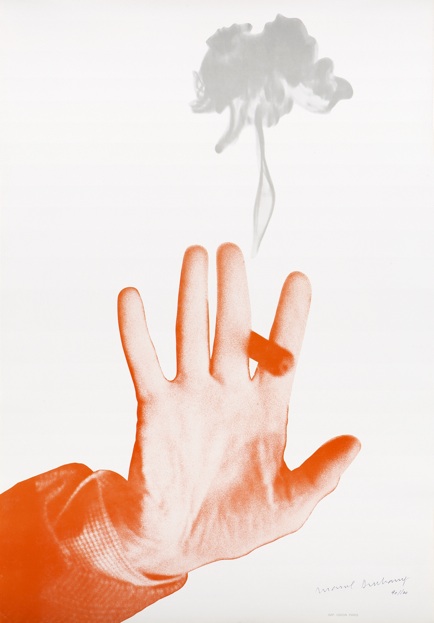
Marcel Duchamp, “Untitled (Hand and Cigar),” 1967. Lithograph. Edition of 100. Norton Simon Museum, Gift of Mr. John Coplans in homage to Mr. Walter Hopps. © 2008 Artists Rights Society (ARS), New York / ADAGP, Paris / Succession Marcel Duchamp]

28 July 2009

Posture and gas


"You walk through the uninviting entrance into a completely dark foyer where you can vaguely perceive that there are a few people shuffling around. Then a flashlight lights up and you put your membership card in its beam. You’ve passed the first test. You go through the doors at the back of the lobby to the stairway. There are two official-looking if a bit stoned attendants there to check your membership number off in a ledger, write down the number of guests with you (you’re allowed two), and write out a bill—$19.00 for three. You then wait in line to go upstairs. This is the tensest part of the evening because you can hear the music from upstairs, and they’re usually playing one of your favorite songs, so you know you’ll miss dancing to it. At the top of the stairs, which are usually crowded with anxious, whispery guys, you pay your money and get your hand stamped with ink that glows under black light. Finally, you’re in, but still not ready for the dance floor. There’s another line at the coat check, which takes forever, because you have to decide there and then how much to take off, and there’s a feverish shuffling of necessities from the pockets of shed clothing to pockets in what you’re still wearing: joints of dust, poppers, inhaler, downs, cigarettes, matches, coke, coke spoon, ethyl chloride (if you’re a rag queen). If you’re smart, you do all of this at home, but that means making the difficult decisions before you’ve got the feel of the place.

"Place: Synthetic materials, industrial gloss, futuristic, spacey,
technologized surfaces and lighting. Enormous plants and
bowls of fruit appear as if technologically produced, having
no similarity to natural objects. Views through doorways to
the outside world are extremely disturbing. Views of reality
look unreal, nightmarish, tacky. Going outside is always a
shock, and it takes days to readjust to ugly reality.
People: Synthetically produced bodies using body-building
machines and protein supplements. Bodies moving en masse,
like cogs in a machine."

– Douglas Crimp
23 July 2009

Sex in the (frankfurt) kitchen


“Irresponsible, reckless, carefree, wild, rich — we were just kids doing drugs and being bad, out at bars every night,” Mr. McGinley wrote in an e-mail message circulated to friends after Mr. Snow’s overdose. “Sniffing coke off toilet seats. Doing bumps off each others’ fists. Driving down one-way streets in Milan at 100 miles an hour blasting ‘I Did It My Way’ in a white van.”

TOM BURR


"a long perfect ash formed on the end of the cigar, the white ghost of the leaf with all its veins and its fainter pungency. It was ignored, in its beauty, by the old man. For it was beautiful. Wilhelm he ignored as well" - Saul Bellow Seize the Day

18 July 2009

Why would 'we' not agree with the division of labour?


"When software enthusiasts tested cartoons using Green Dam, the Japanese Doraemon, a cat dressed in blue, was "safe" to the software. But Garfield, another fictional cat, was sometimes filtered, because the animal is yellow – and the software considers an image with a large area of yellow as pornographic."
Shenzhen Daily, Wednesday July 1st, 2009.

15 July 2009

ONE YEAR AGO TODAY


"I will always be more indebted to those to whose favour I owe the ability to enjoy my leisure without restriction, than to those who might offer me the most honourable employment on earth." - Descartes

8 July 2009

The Great Binge


I discovered the only Morel patch naturally growing on our 17-acre farm through a pre-cognitive dream. Upon telling my dinner guests of the dream I had had that morning, we went directly to the location. In exactly the 20 x 20-ft plot of ground seen by me in dream-travel, Morels were popping up. Nowhere else on our property has a native Morel patch been discovered in the years hence....

Baffling and beguling, Morels continue to tease us with their peculiar sense of humour. If any readers know of similarly unusual encounters of the Morel kind, I would like to know. Please write me c/o Fungi Perfecti, P.O. Box 7634, Olympia, WA98507 USA.

Paul Stamets - Growing Gourmet and Medicinal Mushrooms

4 July 2009

Etobicoke


I had a dream last night I was talking to members of a notable Quebec art collective. After one backhanded chauvinistic comment, a potty mouth school yard retort ensued; "You may think you are clever, you may even think you have skill and talent, but your art is fucking terrible".

28 June 2009

Smoke & School?


"I sit at a wooden desk somewhere in the middle of the room, my notebook and pen at the ready. The desk has been carved with graffiti by previous generations of students, their names gouged into the wood with the sharp vegetable-carving knives they sell in the school shop. Several of my classmates are puffing away at cigarettes, and sit enveloped in clouds of smoke. The young bloke next to me has a lump of dough in his hand, with which he dreamily forms and re-forms the same frilly dumpling as he half-listens to the teacher."

Fuschia Dunlop - Shark's Fin and Sichuan Pepper

26 June 2009

For love or money


"In 1994 I saw, at an acquaintance's dacha, an unusual hook on which clothes were hanging. It was made from an old toothbrush, without bristles, and had been obviously bent over a fire. There was something strange in that moment of recognition. I immediately saw the light, as it were, and recalled similar things that I knew, belonging to my relatives, friends, acquaintances, or acquaintances of acquaintances. Before then I hadn't really noticed them. Now it seemed to me that it would be an interesting task to gather them all together and see them in large numbers - a gathering of equals. The first on the list of candidates to approach was my father who, I remembered, had several strange 'thingamyjigs'. I started my collection with them. Then I set to work on my cousins, aunts and uncles. Then it was the turn of friends, acquaintances and non-acquaintances. After that things started to seek me out themselves. People who liked the idea called me, and continue to call, in order to inform me when, what, and where they had seen something similar. It's clear that the process of searching for things has its own momentum, its own internal logic, and is of a highly accidental nature."


- Vladimir Archipov Home-Made: Contemporary Russian Folk Artefacts, 2006

25 June 2009

"I think art is about the experience of 'subwaying'. When you are standing in the subway, you realise you are part of an inherent group and you have a reason to be going someplace: you no longer have to justify yourself, you no longer have to explain yourself or place yourself, you have a function, you are taking the subway, you are subwaying."

- Lawrence Weiner

18 June 2009

I.T. WORKERS OF THE WORLD


"Yoko Ono requires a phone call from one of her assistants to remind her that she needs to dial in for the Telephone piece" - Kate Moss via Twitter

14 June 2009

Trialogue: beyond the Austrian bourgeois society of the early twentieth century


holding environment? courtesy http://www.flickr.com/photos/lorfiot/

"The kibbutnzik was originally adult oriented. Children came into the vision of the small, self-sufficient, egalitarian commune as something of an afterthought. Desirous of rigorous equality between members, it became evident that the birth of children presented a problem because they gave unequally to the work force. Instead of falling back upon models of child-rearing they had experienced, horrified as they were by the passivity of their own father's accommodations to the shtetl, the kibbutzniks started something new.
Children's houses were established and caretakers (metapalets) were assigned to them. The children are placed under the direct care of the metapalets from their first few weeks onward. They are always in each other's presence in the dormitories and play-yard. Their periods with parents are very carefully scheduled as to time and place. Only after graduating through the hierarchy of children's houses, each graded by age, do children have access to their parents as fellow adult kibbutzniks.
In reality the children of this dream are different from their parents' anticipation. They seem emotionally flatter, less vivid people than their parents. They tend to be materialistic and prosaic, not spiritual or poetic like their fathers. Although not suffering from inner conflict like their parents in which the heights of ecstatic creativity and the depths of paranoid despair were expectable mood swings, these children show, in many respects, those responses of the middle range. Group solidarity, dispassionate but enduring love for their farmland, guide their vocational choices.
While experiencing less volatility, these children may be happier than most children of the industrial age. Continually challenged to do, rather than to feel or to be self-conscious about feelings, and having before them the full range of adult technology available to them in the kibbutz, they fantasize less and are more directly satisfied.
And the father figure? It seems to have gone underground as a distinct introject; fathers form no clear cognitive presence for the internal dialogue of thinking and imagining. In the minds of their children, the figures of veneration and allegiance are the peers, the kibbutz as a whole or the parental pair, not the actual biological father.
The distinctive characteristics of the sabre kibbutznik are not finally drawn by the research literature. One reason for this may be precisely the wider range of options available to the sabre for identification. The young kibbutznik's primary loyalty to peers can lead to violent anti-authoritarianism; or to quiet communitarianism; or to bureaucratic preoccupation. Allegiance to the kibbutz itself can yield a return to kibbutz life as an adult, or it can lead to urbanised massenmench, bourgeois existence, or to militant nationalism in a perennially crisis-torn state. Close identification with the parenting pair can, in turn, evoke caretaking behavior, or romantic idealization of the childless partnering of liberated adults."
– Leighton McCutcheon The Father Figure in Psychology and Religion, 1972.

Holding Environment (note to curators - Love your art(ists) like you love your bad habits)


"...Following the death in 1999 of Castelli, whom Hanne esteemed both personally and professionally (and with whose gallery she exhibited from 1973 to 1995), she found her annual visits to New York far less enjoyable. When, shortly afterward, smoking was banned on major airlines, she reluctantly transferred from Lufthansa to Air India for long-haul flights. After that carrier, too, was forced to conform, she preferred to stay at home. Our meetings thereafter usually took place at her family domain—a cluster of historic brick buildings that served as both residence and extended studio facility—in Harburg, just outside Hamburg. Always gracious and appreciative of the efforts I’d made in undertaking the transatlantic trip, Hanne would begin each meeting by giving me an extended tour through rooms dense with books and artifacts collected over decades, in order to reveal her latest treasures. Some of these objects might be rare and beautiful, but many, equally prized, could be kitsch trinkets bought from sources she’d long cultivated in the United States and Europe. Then, after seating me on a very low chair, as we consumed a bottle of champagne, she would play the newest recordings of the many scores she’d composed...."

Lynne Cooke. Passages Section: Open Work, Lynne Cooke on Hanne Darboven (1941-2009). Artforum International, Summer 2009


8 June 2009


photograph courtesy of artist Jo-Anne Balcaen

"Every few months, Venkatesh goes to the same set of coffee shops in Manhattan and Brooklyn and talks to people who come in and sit down....Venkatesh also asks people if they work for themselves. Over the years, he has observed the rise in the number of people who say yes. This year, he estimated, at least half of his coffee-shop sample was made up of the self-employed. Increasingly, they talk about their fading prospects. In 2005, 16 percent in Manhattan said they were out of work, were looking or had recently given up looking. In April of this year, the figure rose to 37 percent in Brooklyn and spiked to 53 percent in Manhattan. Many of the coffee-shop patrons told Venkatesh that they had maxed out their credit cards and had no savings.
... Venkatesh sees a difference in how freelancers talk about the recession compared with workers who have been laid off. "They're more alone, and they can't help but feel like they did something wrong because they're losing relationships with individual clients" he says. "They think of themselves as ministering to their clients, so they also feel guilty about no longer helping them."

Emily Bazelon "What happened to all those liberated, self reliant, self branded free agents?" New York Times Magazine, June 7 2009.

TOBEY. coked up in the club? a new fragrance for men & women

2 June 2009

"Years later did I enter a mine, its entrance a weeping hole in a cliff that formed the riverbank, the floor being no more than a foot above the level of the river rushing by. A small stream fed into the river with a little sandbank on which a group of muddy kids and women were waiting in the rain for earth to be carried out, it being their job to to wash this for gold. The miners were too poor to have anything but candles, and because the tunnel took a right-angled turn, it was pitch black most of the way. It became clammy and hot and progressively harder to breathe. I couldn't imagine what it would be like to heave a pick and iron bar all day at the pit face. My flashlight revealed intricate roof supports as we sloshed through the sludge. I felt I was choking and then saw the light after turning a bend. Two elderly skinny guys stood there scratching their heads, surrounded by boulders two feet in diameter. An unholy mess. Somehow I had expected a nice flat floor and a neat right-angled wall of stone at which they would be chipping away. A real tunnel, you might say. Instead there was this gruesome disembowelment of mother earth with everything at sixes and sevens, oozing muddy water and nameless fluids.
As I turned to go back, I began to feel curiously at home and cozy in the mine, perhaps because I knew I was on the way out and could start to reflect on this as an experience that I now hand over to you. This is the basis of many theories of history, personal no less than worldly. at first the human being is so immersed in reality, in this case horrific, that she or he has neither consciousness nor self-consciousness. There is no Other, just the interior of the pitch-black mine penetrating your being. Then comes the second part of the story. Evolving differentiation enters the scene. Subject peels off from object allowing for consciousness of self.

Aha! I am having an experience!"

Michael Taussig - My Cocaine Museum


29 May 2009

25 May 2009

Henry Shrimpfield: the slow burn


"The café: generally an extra-familial and extra-professional meeting place, where people come together on the basis of personal affinities (in principle and at least apparently), because they have the same street or the same neighbourhood in common rather than the same profession or class (although there do exist cafés where the clients are predominantly of the same class or profession). It is a place where the regulars can find a certain luxury, if only on the surface; where they can speak freely (about politics, women, etc.), and where if what is said may be superficial, the freedom to say it is fiercely defended; where they play."
– Henri Lefebvre Critique of Everyday Life, 1957

20 May 2009

...who's to say...that if you sat on a bean-bag chair...all day at the office...that that would be a bad thing???


One colleague explained that the company was downsizing. A supervisor said the firm was rightsizing. Still somebody else told me that I was being unassigned. The only way I could really figure out what had happened to me was the tone in all these conversations. Also, I asked my boss point blank, “Am I being fired?” He replied euphemistically, “No, you’re being uninstalled.” Cool.

http://www.deependdining.com/2008/05/sweetbreads-how-sweet-it-isnt-gaucho.html

13 May 2009

The fantasies of Bankers are collective


"He wished to construct a universe of pleasure and relaxation - like Matisse's "armchair for tired businessmen," but more so - and in this he succeeded."

Matisse once said that he wanted his art to have the effect of a good armchair on a tired businessman. In the 1960s, when we all believed art could still change the world, this seemed a limited aim, but in fact one can only admire Matisse's common sense. He, at least, was under no illusions about his audience.

- Text from "The Shock of the New", by Robert Hughes

For sure, he wants to bring you into the paintings: to make you fall into it, like walking through the looking-glass. Indeed, Matisse once said that he wanted his art to have the effect of a good armchair on a tired businessman

Matisse said that he wanted his art to have the same effect as a comfortable armchair on a tired businessman and many of the paintings he left us seem to be the view from that armchair. 'The Egyptian Curtain' is one such view.


"What I dream of is an art of balance, of purity and serenity devoid of troubling or depressing subject matter, an art which could be for every mental worker, be he businessman or writer, like an appeasing influence, like a mental soother, something like a good armchair which provides relaxation from physical fatigue"
Barr, Alfred H. (1966) Matisse: His Art and His Public, New York: Arno Press

The building in Hastings, Nebraska where Kool-Aid was invented


"When asked what Jamaica looked like, Columbus is said to have crumpled a piece of paper in his hand to dramatize the fact that deep valleys and gorges, steep hills and mountains account for over 70 percent of the land surface."

- Rastafari: Roots and Ideology by Barry Chevannes

2 May 2009

Time for Jon


"Who is the Spectator, also called the Viewer, sometimes called the Observer, occasionally the Perceiver? It has no face, is mostly a back. It stoops and sneers, is slightly clumsy. Its attitude is inquiring, its puzzlement discreet. He – I'm sure it is more male than female – arrived with modernism, with the disappearance of perspective. He seems born out of the picture and, like some perceptual Adam, is drawn back repeatedly to contemplate it. The Spectator seems a little dumb; he is not you or me. Always on call, he staggers into place before every new work that requires his presence. This obliging stand-in is ready to enact our fanciest speculations. He tests them patiently and does not resent that we provide him with directions and responses: "the viewer feels..."; "the observer notices..."; the spectator moves...." He is sensitive to effects: "The effect on the spectator is....""
– Brian O'Doherty

1 May 2009

The Kings of Community Art


"For many art-world habitués today, collectivism signals little more than a group of people working together collaboratively, sacrificing the individual autonomy of the one for the project of the many and gesturing vaguely toward numerous aesthetic practices of the 1960s. Useful though this definition might be as a descriptive shorthand, it masks something of the complex historical relationship between the individual subject and the collective – their mutual imbrication within one another – not to mention the extent to which subject formation is necessarily a function of collective identification. Indeed nineteenth-century debates on the collective are inseparable from the political constitution of liberal subjects, and identity politics de facto stress identification with a group. By extension, the practice of pseudo-collectivism in the age of bio-politics wreaks havoc on our assumptions about the subject thought to stand behind it. Shadow "organizations" such as the Center for Land Use Interpretation (CLUI) or the Atlas Group (in effect, the artist Walid Raad) 'appear' to take on the mantle of the collaborative efforts of the past. In their address to contemporary phenomena, they appear to tap into a much longer tradition of collectivism with a decisively political pedigree. At the same time, in presenting their work under the banner of a monolithic rubric, they also renounce the terms of singular authorial subjectivity. In doing so, they offer inadvertently canny insights into the status of the political subject, its identification as either enemy or friend."
– Pamela Lee My Enemy/My Friend

30 April 2009

Presence and Absence in Crowds

"But junk art is now considered tasteful-it has been for many, many years. Three or four generations of artists have produced junk art, so it's hardly avant-garde. But I see signs of market resistance. For example, there seems to be a surge in communal groups that produce art. That's interesting, but a lot of what I see has a retro quality-a kind of nostalgia for the old avant-garde. I don't know if this is an attempt to recuperate those values, or if it is simply laziness. I feel the same way about a lot of contemporary music; I hear a lot of bands that sound like ones I've heard before. I find myself wondering, What is the voice of this generation? I'm sure there is one. I suppose I just cannot recognize it." - Mike Kelley

23 April 2009

'Coked Up in the Club' (The New Fragrance for Men and Women)


"Once I had seen the photograph of [Tony Oursler's] The Influence Machine, and started to think about the way it spoke to our present utopia of information, I could not stop coming up with points of comparison for it from the art of the last 150 years. I thought of the end of modernism in the late 1960s, and of steam, in Robert Morris, as the figure of that ending. I read Morris's steam piece as essentially a literalization of the previous century's pursuit of abstraction, reduction, and dematerialization – its wish to give art over to the moment, the event, to pure contingency. I had my doubts about what Morris's literalization of these impulses did – whether to literalize them was to banalize them – but at least I understood, or thought I understood, where Morris was coming from. And I knew he knew he was at the end of something, so maybe even the banality of the metaphor was deliberate – it showed us what modernism amounted to by 1968. This still left me with the problem of what Oursler achieved by giving Morris's steam a face. That is, by projecting onto modernism's emptying and dispersal enough of an apparition, a suffering subject, a stream of words.
"Then, of course, I began to realize that steam, in the art of the last two centuries, was never unequivocally a figure of emptying and evanescence. It was always also an image of power. Steam could be harnessed; steam could be compressed. Steam was what initially made the machine world possible. It was the middle term in mankind's great reconstruction of Nature. Rain, Steam, and Speed. The speed that followed from compression turns the world into one great vortex in the Turner, one devouring spectral eye, where rain, sun, cloud, and river are seen, from the compartment window, as they have never been seen before. Steam is power and possibility, then; but also, very soon, it is antiquated – it is a figure of nostalgia, for a future, or a sense of futurity, that the modern age had at the beginning but could never make come to pass. Hence the trails or puffs of steam always on the horizon of de Chirico's dreamscapes. A train races by across the Imperial desert. It looks as though the Banana Republic is producing the requisite goods. Or are we already belated visitors here, tourists, gawping at ruins half-overtaken by the sand? Is modernity spreading and multiplying still to the ends of the earth – setting up its statues and smokestacks, having its great city perspectives march off into the distance as far as the eye can see? Or is this a retrospect, a collection of fragments? A cloud of steam in de Chirico is often glimpsed between the columns of an empty arcade. Once upon a time the arches led to the station, and people hurried to catch the express. Not anymore. Once upon a time people gloried in the vastness of the new perspectives, and built themselves dream-houses devoted to the worship of cog wheels and tensile strength. But modernity was always haunted by the idea that this moment of dreaming, of infinite possibility, was over."
– TJ Clark Modernism, Postmodernism, and Steam

20 April 2009

Supplying international art without the shipping costs since 2004


Hi
Whilst it would not be flagged as a phantom item specifically, you can put the parent onto the sales order and use the explode BOM function. This will leave the parent on the order, but not as an item, and the components of the parent as individual requirements.

Depends on the controls you have in place and the requirements of the parent being an item. Is it a true phantom where you never sell it or stock it, or is it a pseudo phantom that whilst usually not sold or stocked it can be if required.

I hope this is clear and helps

Steve

17 April 2009

The Pathological Patron

"You know, sometimes if a villager sees an artist working on a landscape painting, they think the government has given them the land and the artist is making a map. So they take a big stick and... Smash!"

"Smash the painting?"

"No, smash the artist!"

14 April 2009

The perfect synthesis of career and lifestyle


"A second visual clue relates to 'fractal displacement', which refers to the pattern's property of being described by the same statistics at different spatial locations. As a visual consequence, the patterns gain a uniform character and this is confirmed for Pollock's work in the upper inset of Fig. 3, where the pattern density P is plotted as a function of position across the canvas.

In conclusion, Pollock's contribution to the evolution of art is secure. He described Nature directly. Rather than mimicking Nature, he adopted its language - fractals - to build his own patterns."

http://phys.unsw.edu.au/phys_about/PHYSICS!/FRACTAL_EXPRESSIONISM/fractal_taylor.html

10 April 2009

The Hans Namuth re-enactment


Continuity: When the photographer is making the movie of Pollock he "zooms" in on the shoes. But the old 16 mm camera he is using has a three fixed lens turret. He should not be able to zoom. All his other shots are as expected from fixed lenses of different focal lengths.

Revealing mistakes: When Lee asks the man to carve the turkey, he goes through the motions of cutting it, though the knife never touches the meat.

Continuity: As the documentary filmmaker is filming Pollock painting, Pollock's footwear changes from "painting boots" to shoes and back to boots.

Anachronisms: We see a post-1958 Chevrolet truck (with four headlights) when Pollock takes the sick dog to the veterinarian in 1956.

Audio/visual unsynchronized: When Jackson was moving into their fix'er up cottage in the Hamptons, the couple were out doors in the yard. Time of year was late fall with trees in the background having no leaves. At this time of year, the song of a bird (Woodthrush) would not be heard, since a Woodthrush sings during spring and summer months for territorial reasons. Though this bird may still be present in the wooded area around the Hamptons, it would not be singing as such.

Factual errors: When Jackson and Lee first go out to the barn, they discover that it was being used for storage and that, if cleaned out, it might make a suitable studio space. In reality, Jackson and Lee moved the empty barn to improve the view from the upper windows of their house. After moving the barn, Jackson started using it as a studio. This was probably done for the reasons that, since they were shooting on location, and moving the barn would have not only been much more expensive, it would have been illegal as it is a historic landmark.

Eating an abstract to shit a thesis


"Hi all,

so far I've spoken with people at school who are interested in material relating to:

-performance art

-the idea using the very tools and technologies of a system one sets out to critique (especially with regard to representation)

.

best, (...)"

7 April 2009

The Rudiments of Collaboration

RL: Since we’re talking about drawings, in general, is it not true that the ideas that you realize as sculpture have their origin in your drawings?

AA: Yes.

MC: Sometimes.

DR: What? How?


The Object as Protagonist: an Interview with Los Carpinteros Alexandre Arrechea, Marco Castillo, and Dagoberto Rodriguez by Rosa Lowinger. Sculpture Magazine, December 1999 - Vol.18, No. 10.

23 March 2009

"There is green light and red light. Then there is black light, which is mostly danger."

With only a scant amount of daylight penetrating the tent, the works had developed an ethereal glow.

"Once I apply the violet pigments with a brush, the surface will become gold," he said, gazing intently at the 3- by-5-meter, or 10-by-16-foot, paintings resting on wooden sawhorses. "As the light reflects it, it will change color."

His dealer Gordon VeneKlasen, who represents him with Michael Werner, interjected, "Violet has had mystical properties since the Renaissance, which has always fascinated Sigmar."


Sigmar Polke: Inscrutable master of the unexpected, Carol Vogel - The New York Times, 27 May 2007.

22 March 2009

Horn of Plenty

Photo by: Pam Kaminski

"What does disco do? It programs a random-access search for “origins” and incites in the reader a search for sources, which turn out to be hallucinations or echoes of sources. Such a programming language was once called literature (we have chosen to call it art history), though disco, of course, is not a literature at all; it merely simulates the effects of literature (as empty brand) with the uncanny precision of our era’s version of a lullaby: the remix. Disco is a programming language. It simulates the desire to remember when human remembering has become, from a technological standpoint, unnecessary or impossible. Disco thus proposes a solution to the vast volumes of distributed media (now databased on the Internet) that began in the nineteenth century and have snowballed of late—in the form of photographs, tape recordings, films, records, CDs, and hard drives. How in this morass of information, most of it noncontinuous (i.e., digitized and subject to random access memory) can anything be located? Disco proposes a radical minimalization in the accessing of voices, regarded as discrete and modular data.
For as we have seen, disco involved the systematic subtraction of extraneous information “tracks” and elevation of a percussion track into a remix having minimal harmonic or melodic progression, and grounded in repetition. This subtraction would be exploited in the late seventies and early eighties with Eurodisco, Italodisco, minimal ambient house musics; contemporary artist writing/distribution projects; and a host of disco-oriented stylistics and sampling/appropriation-based poetries.
Unlike the other arts that were bracketed by arts of long-term memory (ars longa, vita brevis), disco was keyed not to memory but to what human memory became with the advent of computerized data storage and accessing: a mood, understood as the by-product of an obsolescent human memory system. For this reason it is customary to say that one can “have” a memory but not a mood; it is more accurate to say that a mood overtakes one. Moods, which are not inherently subjective and do not differ significantly from person to person, are a waste product antithetical to precomputer memory and thus nostalgia. So moods are rightly understood as a mode of accessing data inaccessible to human memory. Before the DJ, moods were harder to come by, let alone produce systematically. This was mainly because moods were amorphous and believed to be subject to a certain “distillation.” But with the advent of large-scale computing, things began to change. The verb “to access” was coined in 1962 with respect to “large-capacity memory,” which was viewed as a kind of “happening.” It took less than seven years for a soft synaesthesia of music, lights, dance, and performance to congeal into a cultural format that reflected systemic changes in how collective memory gets processed. As Ebbinghaus says, “How does the disappearance of the ability to reproduce, forgetfulness, depend upon the length of time during which no repetitions have taken place?” (Kittler 1990, 207). Disco solved a crisis in the same way that the core memory inventor An Wang did, whose work in the early fifties on the write-after-read cycle paved the way for developments in magnetic core memory. Wang’s invention “solved the puzzle of how to use a storage medium in which the act of reading was also an act of erasure.” Disco functions as magnetic core memory does, where every act of reading or accessing material destroys the original source (i.e., clears the address to zero), which necessitates the continual repetition or rewriting (the write-after-read cycle) of data."

Tan Lin Disco As Operating System

This conceptual art piece has been patented but not yet produced

20 March 2009

The authors of this Weblog would like to emphasise that they neither endorse nor condone the following remarks


Scams

Con artists are widespread in China. Ostensibly friendly types invite you for tea, then order food and say they have no money, leaving you to foot the bill, while practising their English on you.

Don’t leave any of your belongings with someone you do not know well. The opening economy in China has also spawned a plague of dishonest businesses and enterprises. The travel agent you phoned may just operate from a cigarette-smoke-filled hotel room.


Extracted from http://www.lonelyplanet.com/china/practical-information/health

18 March 2009

Mimesis and Alterity


"The white man who made the pencil also made the eraser."
– Yoruba proverb

16 March 2009

I saw Mike Kelley at LACMA looking at Martin Kippenbergers.


"Company; at table or table d'hôte.... Spinach is served. Mrs. E.L., sitting next to me, gives me her undivided attention, and places her hand familiarly upon my knee. In defence I remove her hand. Then she says: 'But you have always had such beautiful eyes.' ... I then distinctly see something like two eyes as a sketch or as the contour of a spectacle lens...."
This is the whole dream, or, at all events, all that I can remember. (...)
– Sigmund Freud On Dreams

14 March 2009


"To be very, very, very rough: first of all the model of this friendship is a friendship between two young men, mortals, who have a contract according to which one will survive the other, one will be the heir of the other, and they will agree politically - I give a number of examples of this. Which excludes first of all friendship between a man and a woman, or between women, so women are totally excluded from this model of friendship: woman as the friend of a man or women as friends between themselves. Then the figure of the brother, of fraternity, is also at the centre of this canonical model. I show this of course through a number of texts and examples. Brotherhood, fraternity, is the figure of this canonical friendship. Of course this concept of brotherhood has a number of cultural and historical premises. It comes from Greece, but it also comes from the Christian model in which brotherhood or fraternity is essential. Men are all brothers because they are sons of God, and you can find the ethics of this concept in even an apparently secular concept of friendship and politics. In the French Revolution this is the foundation of the Declaration of the Rights of Man. Fraternity was the object of a terrible debate in France at the time, and fraternity appears, between equality and liberty, as one of the foundations of the republic. So, you have to deal here with what I would call a phallocentric or phallogocentric concept of friendship. Which doesn't of course mean to me that the hegemony of this concept was so powerful that what it excluded was effectively totally excluded. It doesn't mean that a woman couldn't have the experience of friendship with a man or with another woman. It means simply that within this culture, this society, by which this prevalent canon was considered legitimate, accredited, then there was no voice, no discourse, no possibility of acknowledging these excluded possibilities."
- Jacques Derrida Politics and Friendship: A Discussion with Jacques Derrida

Forced to Surf (at Gunpoint)